TRINITY: CREATING A SCORE OF EXTINCT LANGUAGES & DYING STARS
CONCEPT & DIRECTION (LENA HERZOG): extinct languages are supernovae, their recordings in the extinct language archives and LIGO recordings of supernovae gravitational waves should be combined, thus collapsing worlds are intertwined in the metaphor and in the score.
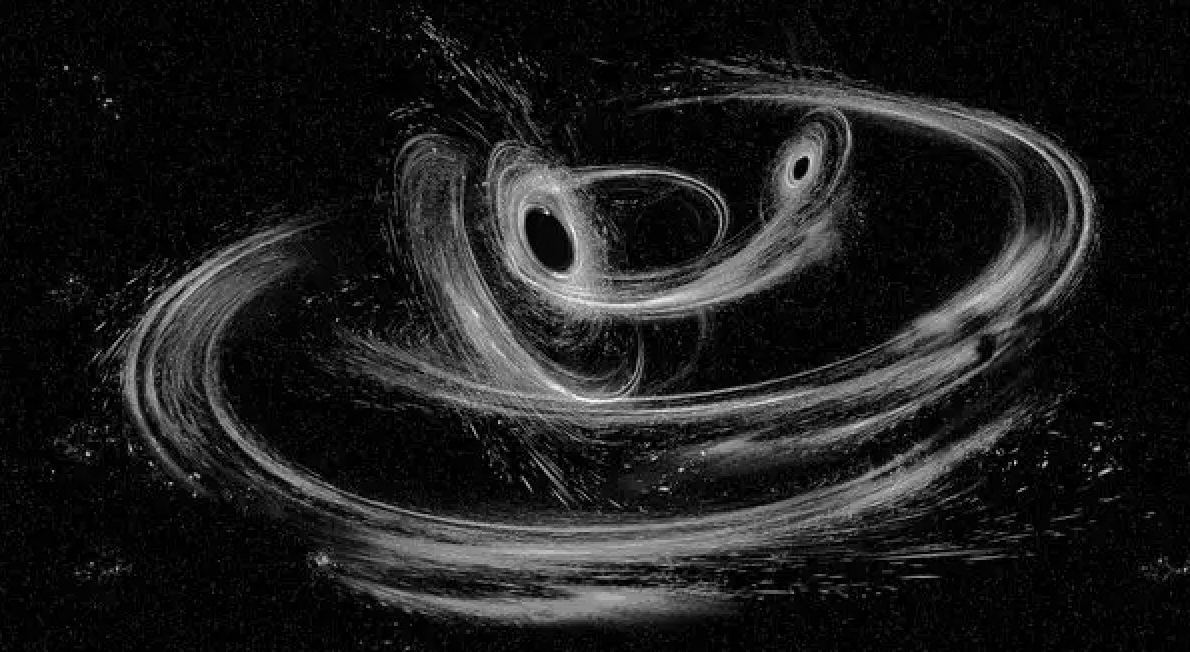
“In 2015, two years before receiving a Nobel Prize in Physics, theoretical physicist Kip Thorne and his colleagues generously contributed the recordings of gravitational waves to the Last Whispers project per my request. These waves were recorded by the Laser Interferometer Gravitational-Wave Observatory (LIGO) that just began to operate that year and to register waves of supernovae, black holes and pulsars. LIGO could detect the difference between cosmic various events via strategically located mirroring systems recording these gravitational waves. The signals were then made audible by converting the frequency and amplitude of the measured spacetime ripples into audio files.
The polyphonic global chorus of extinct languages had the makings of an astonishing oratorio. I knew it after years of listening to the endangered language archives. In order to bring it into a public space beyond the form of the archive, I needed music and imagery that would reveal it in a condensed form—as an oratorio and a four dimensional sound sculpture built around the listener. It had to develop in space (as a spatialized sound design built with many separate channels) and in time. This form had to be invented organically; it had to come from the recordings, from the voices themselves. Marco Capalbo and Mark Mangini, who work fluently in both sound design and in composition, joined the team, and we began to shape the oratorio from the library of recordings that, by then, I already narrowed down. My concept was multilayered and concrete: it included the use of sounds of bells (alarm bell? death knell?), of forest, of wind, and the interpreted gravitational waves from outer space registered by the Laser Interferometer Gravitational-Wave Observatory (a.k.a. “the Listening Ear”). In my first brainstorming session about the work, I wrote to Marco and Mark:
What is the balance of the piece?
What holds it together?
The “founding idea” of making the work is based on the recordings of languages that had already vanished or are well on their way to extinction. The parameters within which the selection was made for the source library—I have defined. This is clearly a glue as the overall idea and basic building blocks. … Using cosmic sounds of the universe within the composition expands the arc. Gives us “eternal” time. I really love the opening with the bell. The end will have to be a giant chorus that builds and builds and then abruptly vanishes—in an exhale.
Shifting from fragmentation to a lyrical cradling of the voices, then back to fragmentation, and ending with a finale of interwoven harmony and dissonance were key to the piece I was constructing with my team.”
—Lena Herzog (director, TRINITY)
“ORA—the root of many words: the mouth, speaking, prayer, aura, a soft wind or breeze, and speech is of course connected to breath, and so to life itself. So here Ora is perhaps a breathing spoken prayer. I used multiple processes in the composition of ORA. I generated sounds through purely electronic means, and I modulated natural sounds using a variety of techniques. The sound layers were arrayed in an eight-by-eight circle, then projected into eight discrete loudspeaker channels, like the rings of some kind of tree, each one bringing us closer to the center. Each loudspeaker is treated as an independent sound source, and sounds are projected and travel through the space in a variety of ways. All the sound was created more or less “from scratch” in a computer-programming language called CSound.
The sounds follow a progression from the cosmic-universal to the natural, the spoken to the sung, the sustained (cello harmonics) to the resonating (bells). The universal sounds are the most chaotic, the bells the most regular. Each of these six elements has its own rhythm, composed in sixfold counterpoint. Each has its solo moment, with the rhythmic proportions reflected in the large and the small. Voices were placed within a time structure in which they could sing and speak, together, alone, in synchronized groups and chaotic masses. I treated the different languages equally, not picking favorites. To this end, I drew upon a large pool of sound files—some 400 in all. The listener is guided into a sonic space where all the words and songs and cries and chants play within a forest of sound, free of meaning, in some mysterious vastness. While few listeners—and even fewer as time goes on—will grasp semantic meaning from the words, everything has the sound of humanness. We recognize the utterances of our brothers and sisters, as well as our shared ability to form sounds to communicate with each other. A variety of bell sounds toll a sixfold sequence of differently timed repetitions. Six bells start together, and they are one beat away from repeating at the very end of the piece, as each bell follows the other in sequence. So, if the piece were extended, the whole cycle would begin again, another breath in some great oscillation.”
— Marco Capalbo (composer, TRINITY)
“I felt that the best way to honor and respect the last speakers was to find the most compelling expressions of their individual languages and bring them to life in a modern, high-fidelity way. After combing through hundreds of hours of interviews, songs and chants, I selected 30 recordings that moved me the most and worked to bring them to life through the use of underscore, montage, and sound design. Though most of these archival recordings were captured monaurally and are of questionable fidelity, we designed an octophonic speaker system so to reproduce the recordings as immersively and experientially as possible. To show off this immersive space, I built an octophonic virtual sound environment in the studio and placed the last speakers within it. I felt that they should live in a world of sound that is as modern as the one we ourselves experience, thereby presenting their stories and songs in as lifelike a fashion as possible.”
—Mark Mangini (composer, sound designer, TRINITY)
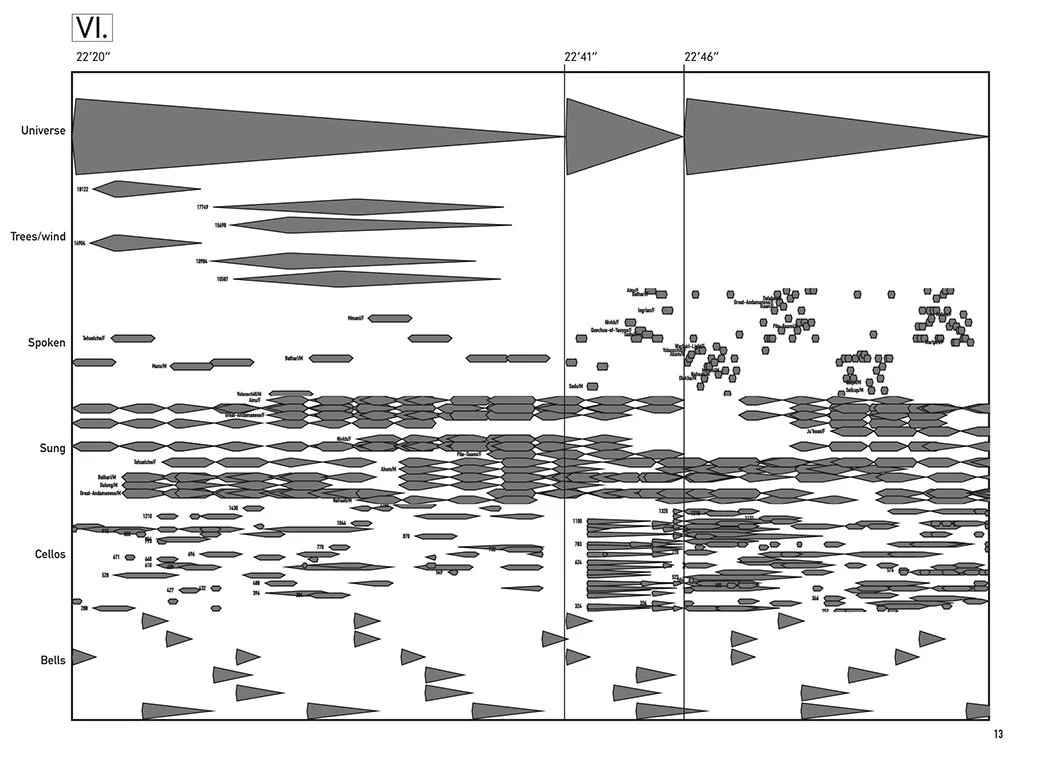
(sketch Marco Capalbo)
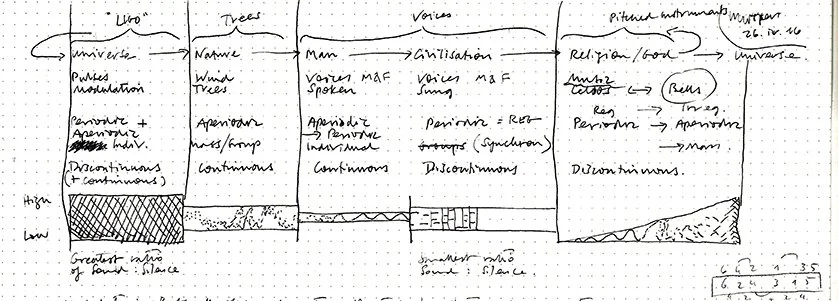
(sketch Marco Capalbo)
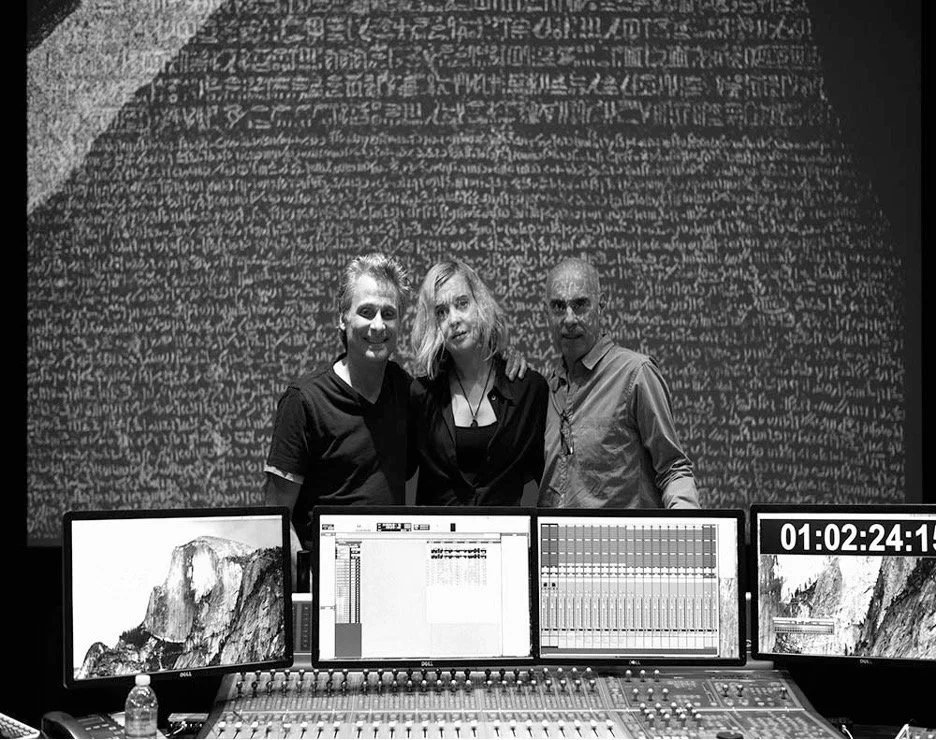
(composers Mark Mangini and Marco Capalbo with author and director Lena Herzog)