TRINITY: THE PROJECT ORIGIN STORY
CONCEPT & DIRECTION (BY LENA HERZOG): An overarching thought that a total physical human extinction follows a cultural one connects the first two chapters. A hope for a reversal, a memory of love, Amor mundi of the third part serve as a counterpoint for the first two.
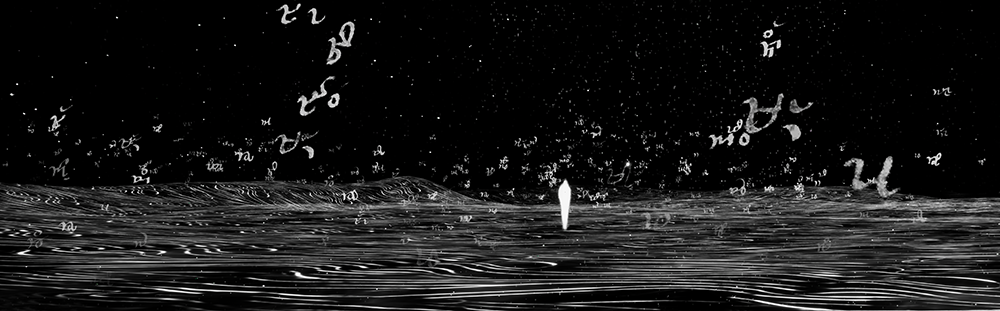
(detail from Last Whispers)
PREAMBLE
Extinct languages are canaries in the mine on our way to singularity and conformity on a mass scale. Their demise is a warning: this is where we are going. Continuously, individually and en masse, the variousness of our human family has been erased. Since silence is the very form of this extinction, by definition, it occurs in silence. Current systems simply leave no room for other ways of thinking and being, even while posturing to do so. The same silencing can be observed in language and thought policing within dominant cultures that also invented the means to end all life on earth in a few minutes via a decision alone in an ultimate and final folly. Politics and our nervous system cannot abide this thought, cannot fathom an end to all life on earth at the same time. This very fact, the most existential issue of all—omnicide by our own hand—is under a strict taboo. As with language extinction, silence covers this fact as well—as a taboo. Thus, it cannot be understood and becomes inevitable. If you cannot say it, you cannot think it—you cannot imagine it, and hence, you cannot control it. To prevent it, it must be addressed and pictured.
THE CHALLENGE
How do you address something that is silent and a taboo? —break them both. Show the beauty and the fragility of the world and show how it can all be lost. Since neither politics nor social commentary are capable of tackling it, this existential issue is left for the poets, the philosophers and the artists. The issues are beyond politics—they are foundational to life.
LAST WHISPERS
“The idea for a project about the mass extinction of languages came to me more than two decades ago. My old failed 2003 Guggenheim application was titled “Vanishing Cultures” and was at first, in part, a photographic project. I planned to take large-format portraits of the last speakers of various languages and place them in a room filled with their whispering voices. The concept of sounding vanished voices by broadcasting them as a muffled chorus was already central and clearly articulated in my description of the project back then. I realized that indigenous communities give up their languages and switch to dominant ones under pressure from the forces of globalization. My next natural iteration of this idea involved shedding the images of the speakers and having only voices in a forest. When a tree falls in a forest and no one hears it, does it make a sound? This old philosophical trope, the basic epistemological exercise, seemed handy. What is our sense of the unobserved, unheard worlds? I have come to think of this old epistemic exercise instead as one in empathy: Does it matter that trees and universes collapse all around us? Somewhere, between our obliviousness to others and our own inevitable oblivion, rest the scales of some brutal justice.
My team and I began amassing a giant library of recordings of extinct and endangered languages on loan from international archives, working closely with many collections, linguists, and anthropologists in the field. Our main collaborator was the Endangered Languages Documentation Programme, a project of SOAS University of London that is headed by Mandana Seyfeddinipur. When I went through their archives online, I realized there would be no point in just “stacking” languages back-to-back to form a single piece. Because these recordings were already public, generously so, it would have been possible to perform this kind of compilation just by clicking “next” on their website, and that would have been too obvious a gesture for the work I had in mind.
While working in my studio and darkroom, I created a setup that randomly played thousands of these recordings, one after another. I marked those that felt right for the oratorio I was planning and began narrowing down the library. The extraordinary researcher Theresa Schwartzman, in Los Angeles, and her counterpart in London, Eveling Villa, began reaching out to archives, linguists, and indigenous communities (when this was possible) to obtain rights and permissions for the recordings. Sometimes there was no community to reach. We went beyond the letter of the law, which held that the copyright resided with the linguists and the archives, and tried to reach those who claimed heritage to the language. Sometimes last speakers changed their minds, turning us down mid-composition and mid-piece, and we had to redo the work from scratch, rescore and rethink. Each case had a story, most often a tragic one.
Every dialogue with a linguist, no matter how banal, brought insight. The professionals who travel and live among these last speakers are the unsung heroes in this story; they are the ones who collect, preserve, and help revitalize endangered languages. In my dealings with them, they were the advocates for the last speakers’ rights. One might think that they would number enough to form an army, but there are barely enough of them for a battalion. Most work alongside volunteers and language enthusiasts. And all of them, at least those that I have met, are on the side of indigenous peoples. To put it in espionage terms, linguists of endangered languages almost always “go native.” They are the ones who hear the trees falling in the forest.
There is lamentation and melancholy in the oratorio. How can it be otherwise? And yet it is not a requiem—it is an invocation of languages that have gone extinct and an incantation of those that are endangered. I myself got addicted to these vanishing voices. I listen to them all the time now. They remind me that despite the deafening noise of our own voices, we are floating on an ocean filled with the silence of others.”
ANY WAR ANY ENEMY
“As Atwood said, “every war is a failure of language.” The nuclear war—is especially so. After all, nuclear war is not war. It is a decision for a mutual suicide and murder on a planetary scale.
A way to end humanity many times over has been created and perfected. The world on the brink of omnicide has been industrialized, financialized and mythologized; and the logic of hatred underpins it all, making peace impossible and global war inevitable.
What will it be like? That end?
I thought of Any War Any Enemy should be both a depiction of any war as well as the “last war.” It is an anti-war immersive poem—a requiem for the world lost to self-destruction. This last moment is “stretched” into a series of mise-en-scènes that build to a shocking finale.
The focus must be on the human beings on the receiving end, which, in the next global war, will be all of us.”
REVERSAL
“There is not enough time left by current technology of omnicide to mitigate, to re-think, to stop the hubris and the hurtling towards annihilation of all life. What could then stop such self-destruction? Would it be love or a memory of it? Conceived as a counter-point to the first two chapters on extinctions. Not a moral tale, but a short list of things worth living for: a human connection, a dance, the natural world and a loving gaze. The goal was to show the fragility of the world and its shocking beauty. If we grasp it, maybe, we might choose to save it.”
— Lena Herzog

(detail from Last Whispers)

(detail from Any War Any Enemy)
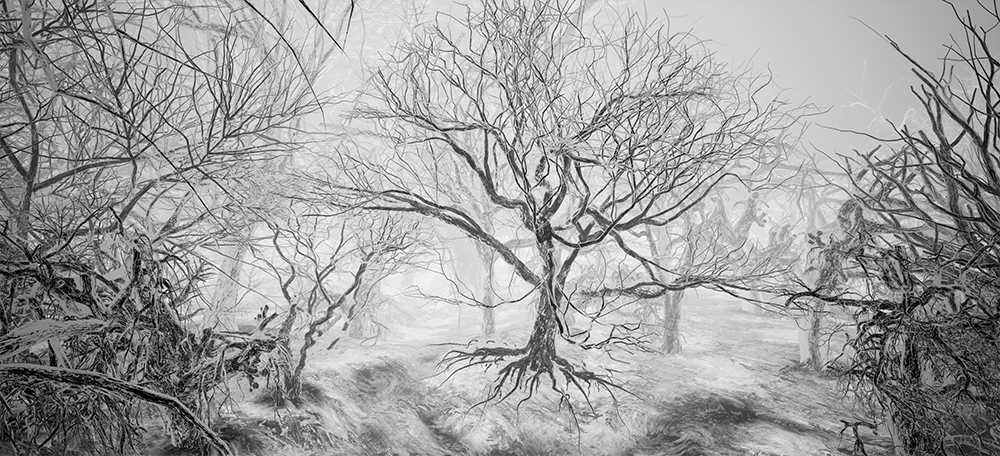
(detail from Last Whispers and Reversal)