PRESS
LANGUAGE EXTINCTION WOULD INEVITABLY LEAD TO A PHYSICAL ONE
by Luca Morino
June 7, 2026
[translation]
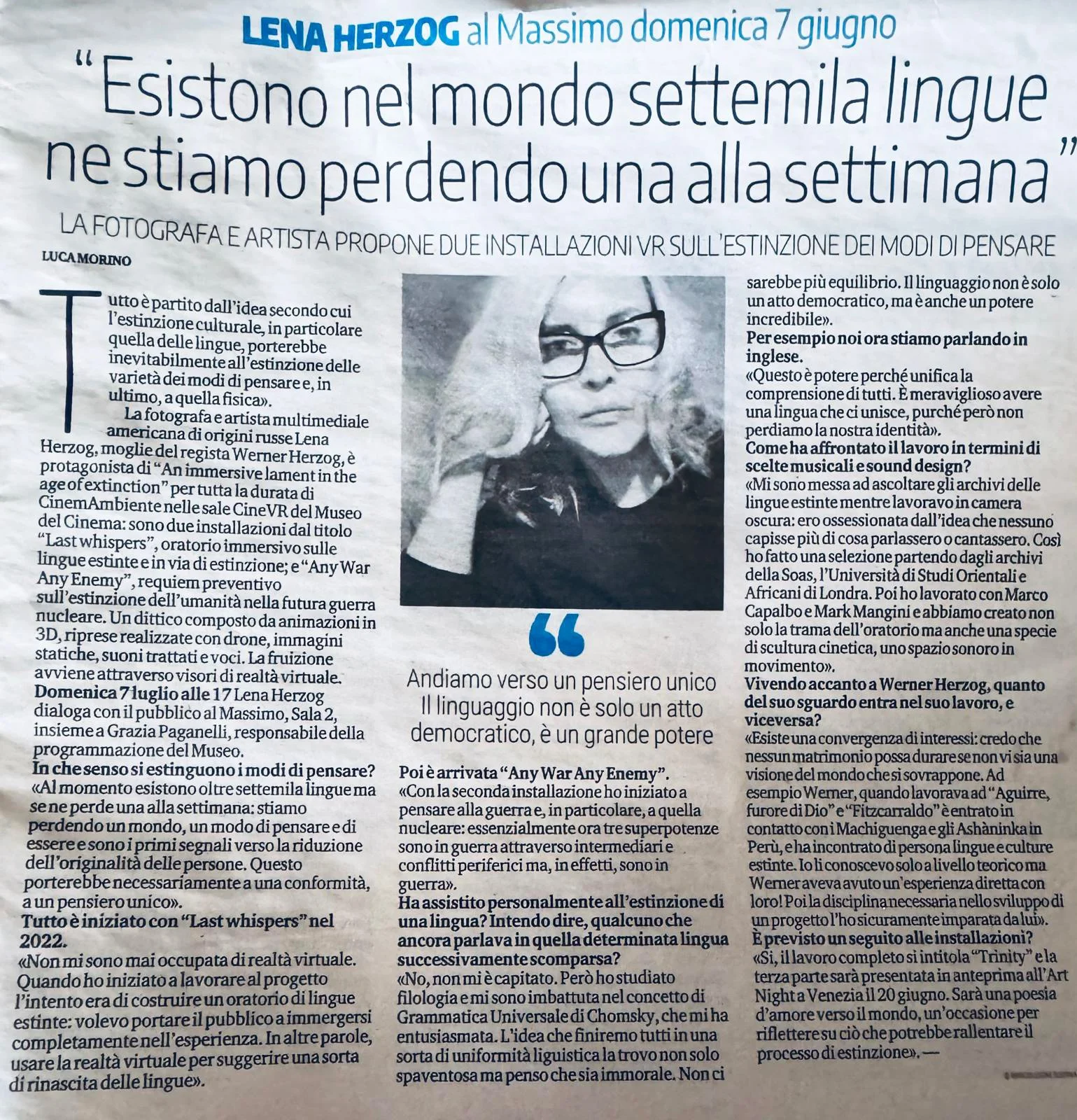
It all started from the idea that cultural extinction, particularly that of languages, would inevitably lead to the extinction of various ways of thinking and, ultimately, to a physical extinction.
Russian-American photographer and multimedia artist Lena Herzog is the author of "TRINITY: An immersive Lament in the Age of Extinction" for the entire duration of CinemAmbiente in the CineVR rooms of the Cinema Museum: the first two chapters entitled "Last Whispers,” which an immersive oratorio on extinct and endangered languages; and "Any War Any Enemy," a preemptive requiem on the extinction of humanity in a future nuclear war. A diptych composed of 3D animations, drone footage, still images, processed sounds, and voices. The experience is through virtual reality headsets.
On Sunday, July 7, at 5:00 PM, Lena Herzog will be speaking with the public at the Massimo, Room 4, together with Grazia Paganelli, head of the Museum's programming.
In what sense are ways of thinking becoming extinct?
There are currently over seven thousand languages, but we're losing one every week: we're losing a world, a way of thinking and being, and these are the first signs of a decline in people's originality. This would necessarily lead to conformity, to a single way of thinking, a singularity."
It all began with "Last Whispers" in 2022.
"I've never worked with virtual reality. When I started working on the project, the intention was to build an oratory of extinct languages: I wanted to immerse the audience completely in the experience. In other words, to use virtual reality to suggest a sort of resurrection of languages." Then came "Any War Any Enemy."
With the second chapter, I started thinking about war, and nuclear war in particular: essentially, three superpowers are now at war through proxies and peripheral conflicts, but they are, in effect, at war.
Have you personally witnessed the extinction of a language? I mean, someone who still spoke that particular language that subsequently disappeared?
No, I haven't. But I studied philology and came across Chomsky's book and concept of Universal Grammar, which thrilled me, [that while there are differences, there is also a foundational connection]. The idea that we will all end up in a sort of linguistic uniformity is not only frightening, but I think it's immoral.
There would be no balance. Language is not only a democratic act, but also an incredible power.
For example, we're speaking English now.
This is power because it unifies everyone's understanding. It's wonderful to have a language that unites us, as long as we don't lose our identity.
How did you approach the work in terms of musical choices and sound design?
"I started listening to archives of extinct languages while working in the darkroom: I was obsessed with the idea that no one understood what they were talking or singing about anymore. So I made a selection starting from the archives of SOAS, the University of Oriental and African Studies in London. Then I worked with composers Marco Capalbo and Mark Mangini, and we created not only the plot of the oratorio but also a kind of kinetic sculpture, a moving sound space.
Living next to Werner Herzog, how much of his perspective enters into your work, and vice versa?
There's a convergence of interests: I believe no marriage can last without an overlapping worldview. For example, when Werner worked on "Aguirre, the Wrath of God" and "Fitzcarraldo," he came into contact with the Machiguenga and Asháninka peoples in Peru, and personally encountered extinct languages and cultures. I knew of them theoretically.
What have you learned from Werner Herzog?
I definitely learned the discipline needed to complete a project from him.
Is there a follow-up to the installations planned?
Yes, the complete work is titled "Trinity," and the third part will be previewed at The Art Night in Venice on June 20th.
It is a love poem to the world, an opportunity to reflect on what could slow the process of extinction.