PRESS
Lena Herzog: «Realtà virtuale? È sguardo libero»
Lena Herzog: "Virtual Reality? It's a Free Gaze"
by Giuseppe Gariazzo
June 20, 2026
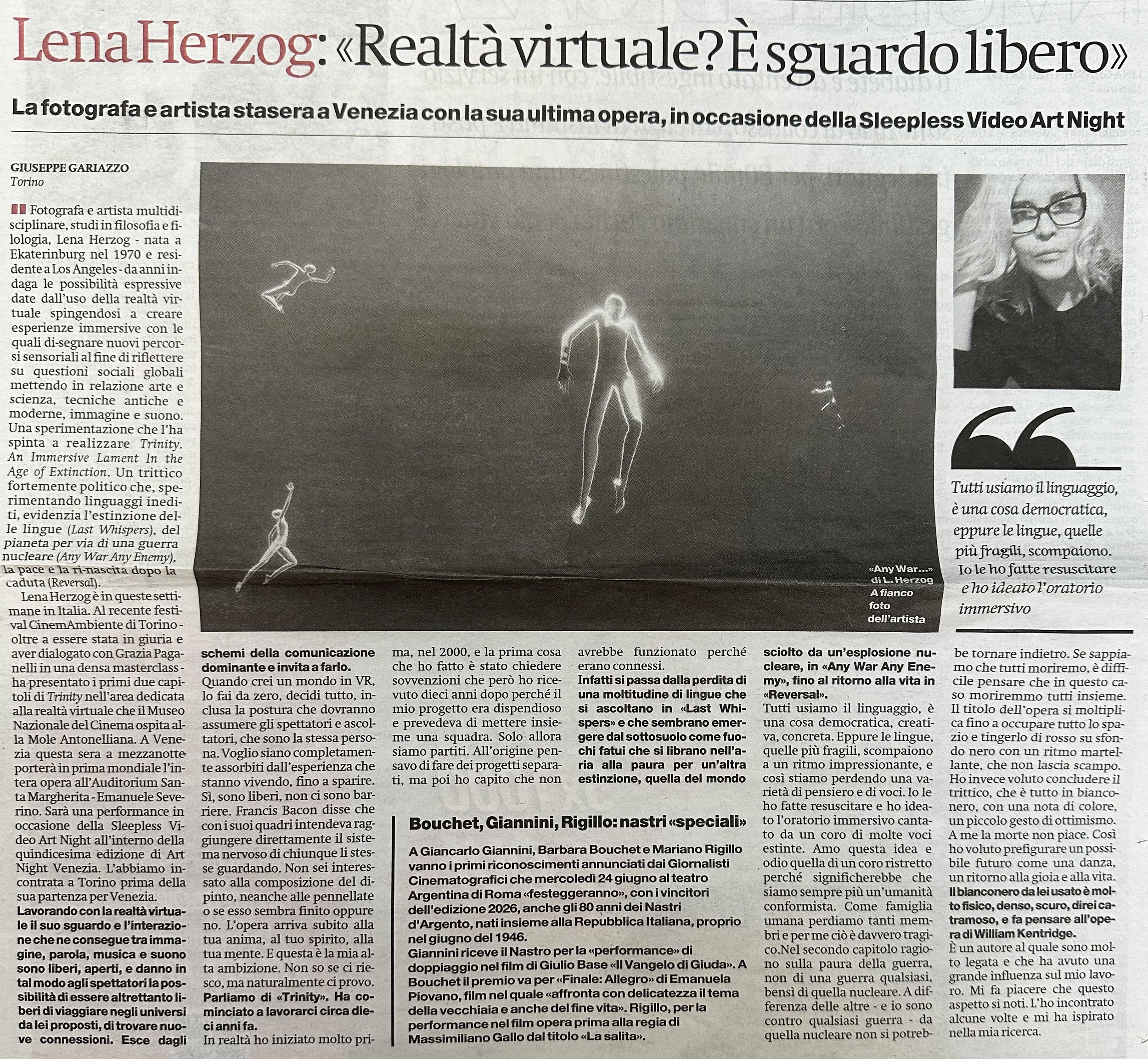
[translation]
Lena Herzog: "Virtual Reality? It's a Free Gaze"
Meeting the photographer and artist will be in Venice tonight with her latest work, during the Sleepless Video Art Night.
A multidisciplinary artist and photographer who studied philosophy and philology, Lena Herzog—born in Yekaterinburg in 1970 and now residing in Los Angeles—has been exploring the expressive possibilities offered by virtual reality for years, creating immersive experiences that trace new sensory paths to reflect on global social issues, connecting art and science, ancient and modern techniques, image and sound. This experimentation led her to create TRINITY: An Immersive Lament in the Age of Extinction. A highly political triptych that, experimenting with new languages, highlights the extinction of languages (Last Whispers), the extinction of the planet due to nuclear war (Any War Any Enemy), and peace and rebirth after the fall (Reversal). Lena Herzog is currently in Italy. At the recent CinemAmbiente festival in Turin—in addition to serving on the jury and engaging with Grazia Paganelli in a comprehensive masterclass—she presented the first two chapters of TRINITY in the virtual reality area of the National Museum of Cinema at the Mole Antonelliana. Tonight, at midnight, in Venice, she will present the world premiere of the entire work at the theater Auditorium Santa Margherita – Emanuele Severino. It will be a performance during the Sleepless Video Art Night, part of the fifteenth edition of Art Night Venice at the Venice Art Biennale. We met her in Turin just before her departure for Venice.
Working with virtual reality, her gaze and the resulting interaction between image, word, music, and sound are free and open, thus giving viewers the opportunity to be equally free to travel within the universes she offers up, to find new connections. She breaks free from the norms of dominant communication and invites us to do so.
When you create a world in VR, you do it from scratch, you decide everything, including the role of the spectators and listeners, who are the same person—the visitor.
I want them to be completely absorbed in the experience they are living through, to the point of disappearing. Yes, they are free, there are no barriers. Francis Bacon said that with his paintings he intended to directly reach the nervous system of whoever was looking at them. You are not interested in the composition of the painting, not even in the brushstrokes, or whether it seems finished or not. The work immediately reaches your soul, your spirit, your mind. And this is my lofty ambition. I don't know if I can do it, but of course I try.
Let's talk about TRINITY. You began working on it about ten years ago.
I actually started much earlier, in 2000, and the first thing I did was apply for grants, which I received ten years later because my project was expensive and required assembling a team. Only then did we get started. I originally thought about doing separate projects, but then I realized it wouldn't work because they were connected.
In fact, we move from the loss of a multitude of languages heard in Last Whispers, which seem to emerge from the ground like fireflies floating in the air, to the fear of another extinction, that of the world dissolved by a nuclear explosion, in Any War Any Enemy, to the return to life in Reversal.
We all use language; it's the most democratic, creative, and concrete action. Yet languages, the most fragile ones, are disappearing at an alarming rate, and so we are losing a diversity of thought and voices. I resurrected them [in the piece] and conceived the immersive oratorio sung by a choir of many extinct voices. I love this idea and hate the idea of a singularity chorus because it would mean we are increasingly a conformist humanity. As a human family, we lose so many members, and for me, this is truly tragic. In the second chapter, I reflect on the fear of war, not just any war, but a nuclear war. Unlike other wars—and I am against any war—there is no turning back from nuclear war. While we know we shall one day die, it's hard to imagine that in this case, we would all die together in one day. The title of the work—Any War Any Enemy—multiplies until it fills the entire space, coloring it blood red with a pounding rhythm that leaves no escape. However, I wanted to conclude the triptych, which is entirely in black and white, with a touch of color, a small gesture of optimism. I don't like the idea of death as an end of everything. So I wanted to envision a possible future as a dance, a return to joy and life.
The black and white you use is very physical, dense, dark, I'd say tarry, and brings to mind the work of William Kentridge.
He is an artist I'm very fond of and who's had a huge influence on my work. I'm pleased that this aspect is evident. I've met him a few times. And his work has always inspired me.